
Call us
301-363-4651 (Available 9 a.m. to 5 p.m. CST from Monday to Friday)

| Code | CSB-EP326837ENV |
| Abbreviation | Recombinant E.coli nrdD protein |
| MSDS | |
| Size | US$388 |
| Order now | |
| Image |
|
| Have Questions? | Leave a Message or Start an on-line Chat |
We recommend that this vial be briefly centrifuged prior to opening to bring the contents to the bottom. Please reconstitute protein in deionized sterile water to a concentration of 0.1-1.0 mg/mL.We recommend to add 5-50% of glycerol (final concentration) and aliquot for long-term storage at -20°C/-80°C. Our default final concentration of glycerol is 50%. Customers could use it as reference.
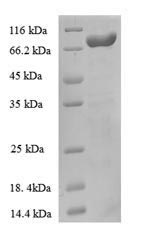
Recombinant Escherichia coli Anaerobic ribonucleoside-triphosphate reductase (nrdD) is expressed in an E. coli system, covering the full-length protein from amino acids 1 to 712. The protein carries an N-terminal 6xHis tag, which simplifies purification and detection processes. It reaches a purity level exceeding 90% as verified by SDS-PAGE, making it suitable for demanding research applications. This product is intended for research use only.
Anaerobic ribonucleoside-triphosphate reductase, known as nrdD, plays a critical role in converting ribonucleotides to deoxyribonucleotides—a vital process in DNA synthesis. This enzyme functions under anaerobic conditions, setting it apart from its aerobic counterparts. It appears to be a key component in the ribonucleotide reduction pathway, which may be crucial for understanding bacterial DNA replication and repair mechanisms.
Potential Applications
Note: The applications listed below are based on what we know about this protein's biological functions, published research, and experience from experts in the field. However, we haven't fully tested all of these applications ourselves yet. We'd recommend running some preliminary tests first to make sure they work for your specific research goals.
Escherichia coli NrdD is a complex enzyme requiring precise folding, cofactor binding, and potentially glycyl radical formation for functional activity. While the homologous E. coli expression system and full-length construct offer a high folding probability, experimental validation remains essential to confirm the functional status.
1. Protein-Protein Interaction Studies Using His-Tag Affinity Purification
This application's suitability depends entirely on proper folding validation. Protein-protein interactions require precise tertiary and quaternary structure for specific binding. If correctly folded (verified), the protein is highly suitable for identifying physiological interaction partners within anaerobic nucleotide metabolism pathways. If misfolded/unverified, the risk of non-specific binding or interaction failure makes results biologically misleading and unreliable.
2. Antibody Development and Validation
Antibody development relies primarily on antigenic sequence recognition rather than functional folding. If correctly folded (verified), the protein excels for generating conformation-sensitive antibodies that recognize native epitopes. If misfolded/unverified, it remains suitable for producing antibodies against linear epitopes, though these may not efficiently detect native protein structure.
3. Biochemical Characterization and Cofactor Binding Studies
These studies are essential for determining folding status and functional competence. If correctly folded (verified), the protein is ideal for validating cofactor binding, radical formation, and enzymatic activity. If misfolded/unverified, characterization still provides physical property data but identifies a non-functional protein.
4. Comparative Structural and Functional Analysis
Meaningful comparative studies require native protein conformation. If correctly folded (verified), the protein enables valid comparisons with aerobic RNR isoforms and orthologs. If misfolded/unverified, comparative analyses yield misleading data as differences may reflect misfolding rather than evolutionary variations.
Final Recommendation & Action Plan
The homologous expression system provides high folding probability, but experimental validation is essential before functional applications. Begin with Application 3 (Biochemical Characterization) to assess folding and function through cofactor binding and activity assays. If verified, proceed with Applications 1, 2 (conformational antibodies), and 4. If misfolded, limit use to linear epitope antibody production (Application 2) and basic biophysical characterization, avoiding all functional studies. Always include appropriate controls for anaerobic conditions in functional assays.
There are currently no reviews for this product.
KEGG: ecj:JW4197
STRING: 316385.ECDH10B_4433